
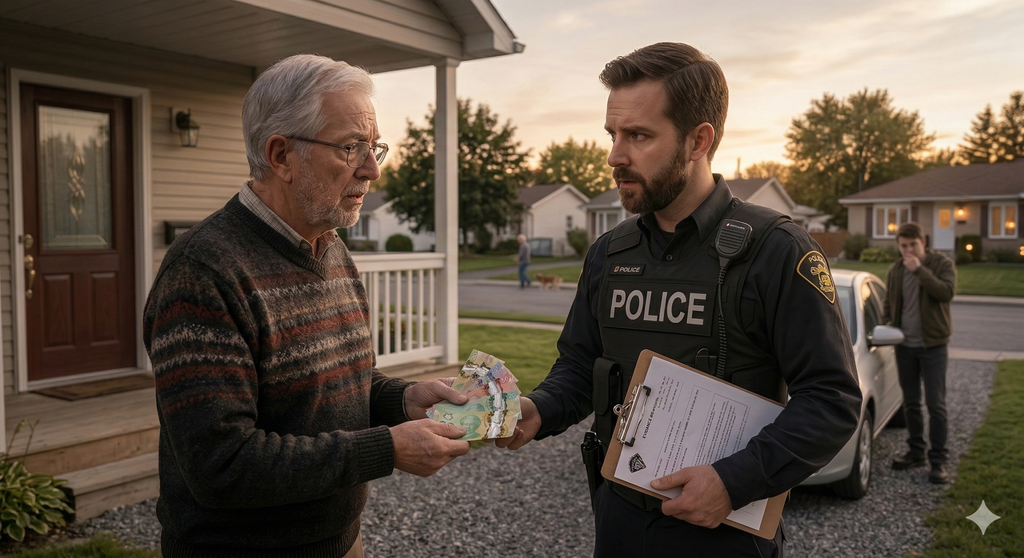
In a growing region like Prescott‑Russell, scams are a reminder that even peaceful communities must remain vigilant
The light gently falls over the United Counties of Prescott and Russell. Residents head home one by one while others walk their dogs before nightfall or chat with neighbours for a few minutes before going back inside.
Then someone knocks at the door and a man identifies himself as a police officer. He says an investigation is underway in the neighbourhood. Fraudsters have been active in the area, and the police say they need residents’ help to identify them.
For some citizens, the situation may seem credible. Authorities regularly talk about fraud in the media and in public awareness campaigns.
But the conversation quickly takes a strange turn when the man asks for money.
According to information provided to residents in the area, individuals posing as police officers reportedly asked the occupants to hand over large sums of money to help them find these alleged fraudsters.
The scene could be straight out of a cop movie. Yet it’s a very real scam that’s increasingly worrying authorities: scammers posing as police officers.
And even in the relatively peaceful communities of Eastern Ontario, such attempts can occur.
An alert in a Rockland neighbourhood
On March 2, residents of the Domaine du Golf area in Rockland received a warning message from their board of directors.
According to the communication sent to owners, suspicious individuals were circulating in the complex. These people were ringing doorbells and identifying themselves as police officers patrolling the neighbourhood, speaking with residents to warn them about possible scammers. They were asking for large sums of money to help them find the scammers. It appears there were 2 to 3 individuals arriving in vehicles.
In a second message sent to residents, the suspects were reportedly described as two men in their mid-30s seen in a small white vehicle.
Then on March 6, the OPP posted the following on its social media: The Hawkesbury OPP, with the support of the Russell County OPP, has arrested three people linked to recent frauds involving fake police officers.
On March 5, a Hawkesbury victim received a call from someone posing as a police officer saying their bank cards had been compromised. A woman then came to their home to collect them, and the cards were used to withdraw cash. Clarence‑Rockland officers later located the suspect and two men. All three were arrested and held pending a bail hearing.
The investigation is ongoing.
Anyone with information is asked to contact the Russell County OPP at 1‑888‑310‑1122 or Crime Stoppers at 1‑800‑222‑8477 to remain anonymous.
Help protect your community: register your security cameras at CAMSafe.ca.
Communities in transition
This incident quickly sparked discussions in the Domaine du Golf community. Some residents said they hadn’t received the emails sent by the neighbourhood administration. Others said they learned about the situation through neighbours or conversations on social media.
As in many communities, information today circulates through a combination of formal and informal networks: community emails, neighbourhood Facebook groups and conversations between neighbours. But the flow of information in news deserts is rarely uniform. Conversations between neighbours, social networks and community emails often become the first sources of information when unusual situations arise.
This can be useful for quickly alerting citizens, but it can also create confusion if the information is not verified.
For a long time, rural areas were characterized by a strong sense of community, where families often knew each other for generations.
In these communities, safety relied in part on close relationships between neighbours. But that reality is changing quickly. Over the past two decades, several municipalities in the region have experienced significant population growth. Municipalities like Rockland, between Ottawa and Montreal, have seen their populations explode, notably due to the arrival of new families leaving major cities to settle in the suburbs. This transformation is gradually changing the social dynamics of these communities.
The closeness that once defined village life still exists, but it’s becoming less and less automatic. Because what brings regional benefits also brings challenges that are transforming the familiar community life of rural areas.
In some newer neighbourhoods, neighbours can live side by side for years, barely speaking to or knowing one another. Others are largely empty during the day. In this context, informal community monitoring — where neighbours quickly notice unusual situations — is becoming less and less common than it used to be. When you factor in changes in information and communication technologies, the whole situation becomes a perfect opportunity for crime, particularly fraud.
Fraud on the rise
What authorities call impersonation scams, where criminals claim to represent an official institution (the police, a bank, or a government agency) and use believable scenarios to convince their victims, are on the rise in Canada.
According to the Canadian Anti-Fraud Centre, Canadians reported more than $530 million in fraud-related losses in 2023. In Ontario alone, reported losses amount to hundreds of millions of dollars each year, making the province one of the hardest hit in the country. Authorities estimate, however, that the majority of frauds are never reported.
According to experts, the rising cost of living due to inflation and high interest rates has increased the risk of fraud. It has in particular increased the financial pressures on potential perpetrators of fraud and their ability to rationalize their behaviour. Remote work, incomplete policies, insufficient training and ineffective controls all raise the likelihood of theft, embezzlement and other forms of fraud and corruption.
These frauds can be particularly attractive to criminal networks, because they can be carried out to generate substantial gains with relatively little risk. Authorities note, however, that fraud is often the work of well-structured criminal organizations that strategically target their victims.
In other words, while economic pressures can contribute to the situation, fraud remains first and foremost an organized criminal activity that exploits social and technological vulnerabilities. In fast-growing communities like Prescott‑Russell, this underscores the importance of strengthening prevention and public-awareness efforts among residents.
The psychology behind the schemes
Experts explain that these scams often rely on what is known as social engineering. Rather than hacking computer systems directly, fraudsters manipulate human behaviour.
In an educational segment for TVC22 on cybersecurity produced in Eastern Ontario, cybersecurity expert Nick Oda of Ginga Technology Solutions explains that criminals mainly exploit victims’ trust.
“Fraudsters don’t always try to hack the technology. Often, they’re simply trying to hack the person,” he explains. According to him, these schemes often rely on three elements: authority, urgency and fear.
When someone presents themselves as a police officer, many people tend to cooperate instinctively. This gives fraudsters an opportunity to exploit that trust. That’s why it’s important to be vigilant toward our neighbours, especially if they are elderly, since these individuals seem to target seniors. Paying attention to and being aware of our surroundings, especially in underground parking garages, could make all the difference.
Social media: between alarm, confusion and collective vigilance
In news deserts like the rural communities of Prescott-Russell, social media has become an important tool for quickly sharing local information.
Neighbourhood Facebook groups often let residents alert their neighbours when something unusual happens. But this rapid sharing of information can also create challenges, especially now that Meta no longer performs fact‑checking. The information shared can therefore be incomplete, hard to verify, or sometimes amplified by rumours.
In some cases, online discussions can even fuel disproportionate concerns. For authorities, this reality underscores the importance of relying on trustworthy, verified sources of information.
The incidents reported in Rockland are a reminder that scams can occur even in relatively peaceful communities. In these situations, collective vigilance remains one of the most effective tools. Authorities remind people of a few simple principles:
- A police officer will never ask for money as part of an investigation
- Anyone can verify an agent’s identity
- Any attempt at fraud should be reported to the authorities.
In Prescott-Russell, policing is provided primarily by the Ontario Provincial Police (OPP). The area is served by detachments located in Embrun and Hawkesbury, with a satellite detachment in Rockland. Officers therefore have to cover a large territory that includes several rural municipalities, villages and agricultural areas.
In this context, citizens’ vigilance can play an important role in detecting suspicious activity. Authorities regularly encourage citizens to report any unusual activity.
In many investigations, information provided by residents helps authorities identify suspects and details such as:
- the individual or individuals (man or woman), skin colour, description of clothing, language spoken and whether they had an accent, and/or any mark they may have had on their clothing, such as a fake badge or identification;
- the vehicle(s) (make and model, colour, SUV or sedan (2-door or 4-door));
- license plate number if possible (from Ontario or another province);
- where the vehicle(s) were last seen (parking spot number) or in front of which building number; and whether they had a pet with them, and if so, the pet’s breed, size (large or small) and colour
In a region like Prescott-Russell, where the population continues to grow rapidly, information and collaboration among citizens, institutions and authorities remain essential for preventing this type of crime. Even in the quietest places, scammers may try to take advantage of people’s trust. But an informed community remains one of the best protections and helps authorities understand the circumstances of an incident.
Sources: Canadian Anti-Fraud Centre https://antifraudcentre-centreantifraude.ca; Statistics Canada — 2021 Census
https://www.statcan.gc.ca; United Counties of Prescott and Russell https://en.prescott-russell.on.ca; Ontario Provincial Police (OPP) https://www.opp.ca; Cybersecurity capsules — Studio TVC22 / GingaTech https://www.youtube.com/@StudioTVC22/search?query=cybersecurity