
A winter break that brings people together… and builds sustainable communities
By Renée Gratton, TVC22
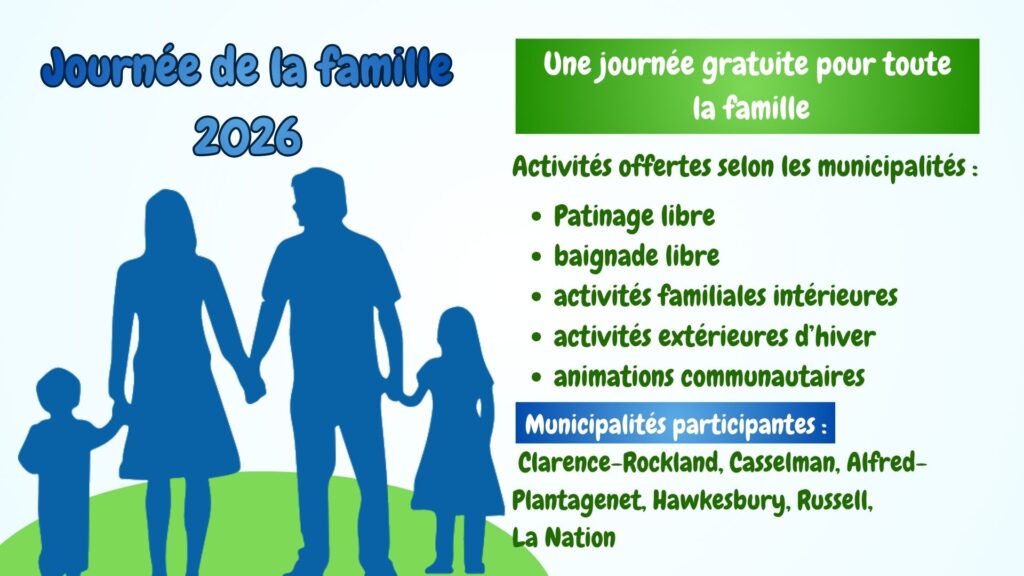
Free skating, swimming, hot chocolate, pony rides and first sledding runs: on the third Monday in February, the municipalities of the Comtés unis de Prescott-Russell (CUPR) mark the Journée de la famille with activities open to everyone. But beyond the winter holiday, the day takes on a particular significance in a rural region undergoing demographic change. For many newcomers, it will be their first experience of a Canadian winter in a community — and perhaps a pivotal moment in their integration.
Established in Ontario in 2008, Family Day is a provincial holiday meant to encourage families to spend time together and to foster community gatherings. In larger cities, there’s no shortage of activities. In a rural area like Prescott-Russell, however, each municipal event takes on a different dimension: it becomes a true gathering point for the community.
In February, winter is in full swing. Temperatures can be harsh, and the days are still short. Opportunities to get out and gather are precious.
Arenas, municipal pools, community centres, libraries and other public spaces turn into places of social cohesion for a day.
In several municipalities of the CUPR, more than 60% of the population can hold a conversation in French. This region therefore remains one of Ontario’s francophone strongholds. Its vitality rests both on its history and on the recent arrival of new francophone and bilingual families.
It is in this context that Family Day takes on a broader meaning. The following activities are just a sample of what families in the region can enjoy.
Clarence-Rockland: a variety of activities and intercultural openness
La Cité de Clarence-Rockland is offering an expanded program for February 16, 2026. According to the official poster and information provided by the City, activities include:
- Open swim at the Clarence-Rockland YMCA
- Public skating at the Clarence-Creek Arena
- Pony rides
- Cultural gathering and tasting with Indigenous Grassroots Circle
The addition of an intercultural activity, in partnership with Indigenous Grassroots Circle, brings an important dimension. The opportunity to meet and sample a traditional Indigenous beverage provides a space for cultural dialogue aimed at making our public spaces welcoming and accessible to everyone.
Free and diverse activities help reach a wide range of families, including those who might hesitate to participate in paid activities.
Casselman: sports, accessibility and community spirit
The Municipality of Casselman is also posting a program for Family Day on its municipal calendar. Planned activities include:
- Public skating at the arena
- Indoor family activities
- Community events
Casselman has traditionally focused on accessible sporting activities that encourage intergenerational participation. Public skating remains a key activity, particularly popular with families with young children.
The municipality encourages everyone’s participation, and Family Day often becomes an opportunity to meet neighbours, teachers, volunteers, and elected officials in an informal setting.
Alfred-Plantagenet: the outdoors as a catalyst for bringing people together
The municipality of Alfred-Plantagenet, meanwhile, is offering outdoor winter activities and a community gathering to mark Family Day.
The posted details list outdoor activities suitable for the season. Access to natural areas and community facilities allows families to enjoy the winter safely.
The outdoors remains a strong part of the identity for many rural communities. Family Day then becomes an opportunity to celebrate this environment.
Russell, Embrun, La Nation and Champlain
Although, at the time of writing this article, no detailed schedule for Family Day 2026 had been clearly posted publicly on the respective municipal platforms, the municipality traditionally organized:
- Public skating
- Activities at community centres
- Indoor family activities
Residents are encouraged to consult municipal channels, such as social media, or to contact their municipality. The lack of detailed public information at the time of writing does not necessarily mean there are no activities, but highlights a recurring issue in rural areas: accessible, centralized dissemination of information.
Hawkesbury: centralized programming
The Town of Hawkesbury offers programming at the Robert Hartley Sports Complex, and activities typically include public skating, sports activities and family activities.
The centralized model allows families to participate in several activities in one location, simplifying logistics.
Rideau Canal
For locals, as well as for newcomers who have never experienced the Rideau Canal, Family Day is an excellent opportunity. “Every winter, the NCC turns the Rideau Canal into the world’s largest naturally frozen skating rink. The Rideau Canal skating rink stretches 7.8 km through the heart of the National Capital. A UNESCO World Heritage Site, the Rideau Canal becomes a winter jewel that fills the National Capital with pride and is a must‑visit destination. ” (National Capital Commission – NCC)
Those interested should check the ice conditions on the CCN’s official ice page, but even if the ice isn’t ideal for skating, walking with friends and family and stopping for a famous BeaverTail and a hot chocolate is another lovely local experience.
A first Family Day for several newcomers
Recent population growth in the CUPR is partly due to immigration. Many new families are choosing the region for its quality of life, its French-language schools and its proximity to Ottawa.
But for families from West Africa, Europe or the Middle East who have recently arrived in eastern Ontario, celebrating Family Day is not only an opportunity to discover the Canadian winter in February, but also often a first experience of skating, sledding, or ice fishing; a first time taking part in a municipal winter event; or a first large-scale community gathering
For some who have never seen snow, those first experiences bring a range of emotions — from excitement to fear. But when another family takes the time to show them how to lace up their skates, or invites them to join, it can be the start of wonderful friendships.
Simple interactions — a piece of advice, a smile, an invitation — directly contribute to a sense of belonging and cultural learning. After all, adapting to winter is an integral part of the process of integrating into Canada.
Understanding how to dress appropriately, learning ice safety rules, and coming to appreciate outdoor activities — these are as much cultural as practical lessons.
Family Day becomes a space for informal learning, and free activities reduce financial barriers, an important factor for some recently settled families.
Inviting people to include and support can make all the difference: inviting a newly arrived neighbour to take part, offering carpooling, explaining how activities work — these gestures help newcomers integrate. In a rural area where social connections may be limited for new residents, these public moments become important anchor points.
Welcoming a new neighbour in winter can be as simple as personally inviting them to municipal activities; telling them what to bring (skates, a helmet, warm clothing); offering to carpool if needed; helping them learn to skate; and introducing them to other families. A host of small gestures can turn a simple outing into a lasting experience of inclusion.
Local initiatives that align with a broader vision
Even if they don’t formally state it in their communications, many municipalities and organizations help build inclusive, sustainable communities through their initiatives.
The United Nations’ Sustainable Development Goal 11 aims to make cities and communities inclusive, safe, resilient and sustainable. Two of its targets are: 1) By 2030, ensure access for all, especially women and children, older persons and persons with disabilities, to safe green and public spaces. 2) Strengthen efforts to protect and preserve the world’s cultural and natural heritage.
By offering free activities and services in municipal facilities — arenas, pools, community centres — municipalities, organizations, and businesses like SHARPSK8S make a tangible contribution to this goal.

This also aligns with priorities often expressed at the local level, such as strengthening the social fabric, improving access to services, supporting quality of life, or helping retain families
As the 2026 municipal elections approach, these issues could play an increasingly prominent role in public discussions and represent a socio-economic impact that is often underestimated
Beyond the social aspect, Family Day also generates modest but real local benefits. Families who take part in municipal events often extend their outing with a stop at the neighbourhood café, the grocery store, or a local restaurant. In rural municipalities, these days provide an added opportunity to boost the local economy.
Businesses located near arenas and community centres often see an increase in foot traffic during these public events. While the primary goal is social, the economic ripple effect helps support local small businesses.
On a human level, the benefits are even more profound. Free municipal events reduce inequalities in access to recreation. As the cost of living rises, offering free activities allows all families — regardless of their financial situation — to take part in community life.
Municipalities that invest in this kind of initiative thereby reinforce a virtuous cycle: social inclusion, local economic vitality, and a stronger sense of belonging.
In a growing region like Prescott-Russell, these elements directly help retain young families and boost the area’s appeal. A vibrant winter community sends a clear message: here, we don’t just live — we live together.
Here, Family Day goes beyond mere entertainment. It can become a symbol of welcome; a tool for integration; a moment of cultural transmission; a concrete demonstration of what a sustainable community looks like
And sometimes it all begins with a first winter outing — together.